Pages

Wednesday, March 19, 2014

A Bushel's Worth: Part Two


This is the second of a two-part article. The first part was published March 12.
by Kayann Short
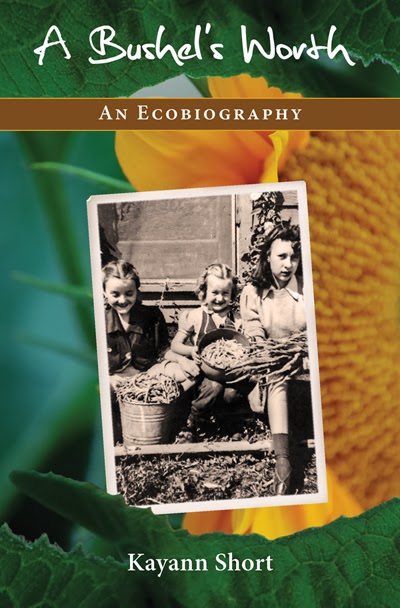
Kayann and her sister Kari (front) at their grandparents' farm.

As I began compiling the bits and pieces of my farming stories in a new draft called Farmroots, I borrowed from digital stories I had created about my great-grandmother’s teaching and farming lives, which now seemed so close to my own. I also drew from blog posts about my two prairie grandmothers, using one of their diaries to describe the weather and land that shaped their day-to-day tasks. I alternated chapters about Stonebridge with North Dakota memories, loosening the seasonal structure and adding photographs and recipes to illustrate the connections between the farms.

Once again, I sent queries to New York agents, who this time told me that interest in farming had already peaked. One agent even said she’d gone down to her local bookstore and found a “whole shelf” of farming books. It seems another farming book would be hard to sell without a national platform, one I didn’t have.

A whole shelf of farming books didn’t sound like a lot to me, but I understand the topical cycles of conventional publishing. I noted, too, that many of these farming books were about, in the words on one back cover, urbanites “escaping city ways.” My book was not about escape, but rather about reunion with my family’s farming past on our own Colorado land. I decided I needed an independent publisher who understood stories of the West. And that’s when I found Torrey House, whose mission is “to increase appreciation for the importance of natural landscape through the power of pen and story.”

As I prepared the manuscript one final time, I brought the Stonebridge story up to date. Torrey House co-publisher Kirsten Allen urged me to emphasize some of my concerns about farming. I joked that I didn’t want to seem too big a worrier, but that last summer finishing the manuscript upped the worry ante with injury, drought, and wildfire. I strengthened, too, environmental themes by including my fifth-grade memory of the first Earth Day, childhood camping trips in the Rockies, and discussion of development pressure along our foothills corridor with its attendant urgency for local farmland preservation. We titled the book A Bushel’s Worth after the chapter about Stonebridge’s instructive attempt to grow wheat. The subtitle comes from my own idea of “ecobiography” as ecology-based memoir at the intersection of nature writing and personal narrative.

Writing, like farming, takes persistence, patience, and a belief in the regenerative power of work, all lessons I surely learned from my grandparents and from the land itself. The generous support I’ve received from Women Writing the West members has been a wonderful boost on my journey, as has the encouragement of friends and family. My path to publication wasn’t easy, but I kept going until I found my niche.

At readings for A Bushel’s Worth, I offer this advice: write the stories you want to see in the world. With all the publishing opportunities today, be open to options that offer a better fit. Be open, as well, to revision and new ideas about your writing. Be flexible and welcome feedback, adapting what you need to further your greater vision. Once your book is in the world, keep listening. Stories don’t end with a book’s publication. Each reading provides another chance to harvest the stories we share.

Kayann Short, Ph.D., is the author of A Bushel's Worth: An Ecobiography. She is a writer, farmer, teacher, and activist at Stonebridge Farm, an organic community-supported farm in the Rocky Mountain foothills. Short’s writing has appeared in Pilgrimage Magazine, Colorado Gardener, Redstone Review, Women’s Review of Books, The Bloomsbury Review, Edible Front Range, and various academic journals. Short has taught ecobiography workshops on “Writing the Self in Nature." Read more about Kayann at her website.

Wednesday, March 12, 2014

Organically Grown in the West: A Bushel’s Worth: An Ecobiography


This is the first of a two-part article.
by Kayann Short
 
A journal. Newspaper clippings. My grandmother’s diary. Some weather reports. I started gathering seeds for A Bushel’s Worth before I knew I was writing a book.

Like all memoirs, mine began with the stories I wanted to remember, entries recorded in my journal from the day I moved to Stonebridge Farm, a ten-acre, century-old farm on Colorado’s Front Range. I wasn’t a consistent journal-keeper, instead noting the most memorable occasions: wildlife encounters, extreme weather, the vicissitudes of fieldwork, poignant celebrations, frightening risks, and always, the first day of the New Year.

Those were the stories I wove into a draft of Farmgiving, a term I created to mean lessons learned from the generosity and bounty of the land on which we grow vegetables for our community. The idea for the book came to me on a women’s writing retreat in a wintery Chautauqua lodge. I had already begun one essay—which became the chapter “Appling,” about our annual apple pressing—and at the retreat, plotted out eleven other chapters that followed our farm through one year. I grouped them by season and placed an event at the center of each. And then I began writing.

It took about a year to finish that first draft, in part because I wanted to follow the farm through the seasons by capturing the rhythms of our days. Once finished, I sent query letters to agents who specialized in nature writing and women’s memoirs. A few asked to see the manuscript. Their feedback was helpful and accurate: I had written two books. One, in their words, was a “nuts and bolts” guide to small-scale farming; the second, a lovely but “quiet” memoir that would be harder to sell in this publishing era of tragedy, disclosure, and scandal.

While waiting for these responses, I turned fifty and began Pearlmoonplenty, a blog about farming, food, books, and feminism. Started as a site for writing practice, the blog became a place to deposit ideas outside the book. Many of these stories came from my childhood summers on my grandparents’ farms in North Dakota. Some of them particularly resonated with my readers, whose enthusiasm encouraged me to continue in that vein. One day, I realized that my book needed to include those early experiences because they formed my farming roots. I could also show the continuity between then and now in small-scale farming and draw stronger connections between my family’s farms and Stonebridge with themes like rural thrift, family legacy, agricultural preservation, and farm-centered community.
 

How did Kayann incorporate her experiences in a book? Read the rest of her journey to getting published next Wednesday.

Kayann Short, Ph.D., is the author of A Bushel's Worth: An Ecobiography. She is a writer, farmer, teacher, and activist at Stonebridge Farm, an organic community-supported farm in the Rocky Mountain foothills. Short’s writing has appeared in Pilgrimage Magazine, Colorado Gardener, Redstone Review, Women’s Review of Books, The Bloomsbury Review, Edible Front Range, and various academic journals. Short has taught ecobiography workshops on “Writing the Self in Nature." Read more about Kayann at her website.

Wednesday, March 05, 2014

Connecting the Past and Present: The age old tradition of Livestock Branding


by Natalie Bright

The alarm clock blasts the silent morning. Time to get cracking, on eggs, that is.  The scene outside my window hides in shades of gray, and I’m thinking about the dugout dating around1895 that established the headquarters of the Sanford Ranch.
The dirt dwelling has endured many transformations through the years as evidenced by crumbling cement, sagging roof, and rusted plumbing. How many countless families and ranch hands have called this crude shelter home? I wonder about the woman who once lived there. Garland Snow Whiteside Sanford would have risen before sunrise, just like me, for spring branding.
She most likely had great dreams of building a life in this place where no one had ever lived before. Arriving as a newlywed in 1901, the original dugout became the back room to a two-story dwelling. Years later the wooden house was destroyed by fire, however the dugout remained and was used for a cowboy bunkhouse.
As I listen to sizzling bacon, I imagine Garland Snow had a cast iron skillet much like mine. I wonder if she was lucky enough to have a wood-fired cook stove, or perhaps she cooked on an open flame.
With spurs jangling, hungry men file past me for breakfast. I realize that time has not changed the fundamental need for the working cowboy. These men really do work from “can see to can’t”. In the pre-dawn light, I watch a frenzy of brushing, saddling and stock trailer loading. Our Ranch Manager wants everyone in their assigned pastures by first light.
The joy of another opportunity to greet the rising sun on horse back shows on the old-timers faces. The younger men are unable to suppress their grins, and the perceptive, skittering horses are anxious as well. In what seems like no time at all, men, horses and cattle will squeeze through a gate into a set of working pens and the peaceful morning will explode with frantic calls of mommas and the answering bawls of their babies.
 The sky dawns bright orange, pink and blue. I figure Mrs. Sanford might have taken a moment to appreciate the stunning site before she washed dishes, stirred beans, and prepared the beef brisket. The menu hasn’t changed much.
As a western writer, it’s important that I strive to help others understand about the rich traditions, the magical land, and the back-breaking labor that  embraces a part of history. Some people might not realize we’re still here. We are. Just over the next rise, at the end of the paved road, this centuries old work continues.

 “Let the wilderness drive us forth as wonderers, scatter our broken bones upon these sands…it shall not kill the purpose that brought us here…the dream still lives, it lives…and shall not die.” PAUL GREEN


Natalie Bright is an author, blogger, and enjoys speaking about history and story craft. Her stories and articles have appeared in numerous publications, most recently this March “A Cowboy’s Life” will appear in Appleseeds. She is represented by Mr. Stephen Fraser, of The Jennifer DeChiara Literary Agency, NYC, who is currently shopping her western novels for middle grade readers. She holds a BBA from WTSU, her husband is a geologist and cattle rancher, and they have two teenaged boys. She’s on the web at Facebook/Natalie-Bright-Author, Twitter @natNKB, Amazon Author Pages, Pinterest/natbright, her website is http://www.nataliebright.com, and she blogs every Monday at http://wordsmithsix.wordpress.com
 

Wednesday, February 26, 2014

Looking for Fame in All the Wrong Places

by Anne Schroeder

Wow. I’m so happy to be writing this. The event I have been working toward for the past five years is finally happening. I signed a contract with Oak Tree Press for my first historical Western novel. It has a name—Cholama Moon.

 Lucky me, right? Actually, the trail has been long and convoluted. One, I suspect, not unlike a lot of other writers.

Several years ago, I started writing and submitting short stories. I entered a few contests. Won a number of firsts, seconds and honorable mentions. Plastered my office with these atta-boys to inspire me in the dark hours.

One of the contests I entered was a San Joaquin Valley Sisters in Crime competition. I don’t write mystery, but the judge liked my story so much that she awarded it an honorary Coveted Dead Bird award.

I continued to write memoir. First, Branches on the Conejo, then Ordinary Aphrodite, about the Baby Boomer experience sans the drug, sex and rock and roll. Through it all, I wrote novels.

 If asked to define what I wrote, I would say, “I write mainstream women’s inspirational novels with
elements of romance, set in the West.” Agents' eyes would glaze over, but I had a vision.

One year I pitched a manuscript at the Mount Herman Christian Writers conference. The agent asked a fair question: Did I read Christian genre? Um, not really. Francine Rivers, Karen Kingsbury, Mary Connealy—but, then, who doesn’t? A couple of Amish romances. He was not impressed and I had to face the truth that I was never in the game.

 So, ummm, what do you write? (asked the next agent at another conference.) Well, I write women’s fiction. Ahh…(with an encouraging nod,) Romance.

Well, not exactly. That is to say, true love triumphs in the end, but my books are more than two people running towards each other, gauzy shirts flying. I write mainstream women’s inspirational fiction with elements of romance, set in the American West.

Old habits die hard. But I was starting to wonder, what is so hard about this concept?

 Because I love to read them (hmmm, where had I heard that before?) I began writing plain, old-fashioned western stories with strong female protagonists. Bingo! Historical westerns. Nothing more. Implied in the term are the things I didn’t need to say—inspiration, old-fashioned values, a ton of research, a compelling story. A boy and a girl.

Long story short, the mother of the judge who awarded me the Coveted Dead Bird award was now working for Oak Tree Press, who was (happily for me,) bringing out a line of historical westerns. I queried. She remembered my name (and the story.) She fast-tracked me through the submission process. And the rest, as they say, is history.

 But since good luck runs in threes, there’s even more!

I am a member of Women Writing the West. At one of their conferences I won an audio book contract from Books in Motion. At another conference, I entered a short story in the LAURA Short Fiction competition. A few months ago a screenwriter read it and asked for a script. We worked on it together—emailed it back and forth until it shone. Now my little short story, Last Dance, is the script that two mock production companies are developing at a film school in Santa Fe.

Suddenly all the unconnected moves I have made in the past several years turn out to be the right moves. Pretty lucky, you think? But every fiction writer has a mantra posted on their computer: “Publication is a Process, not an event.” 

Please share how your process has evolved. If only as a cautionary tale, like mine.

Read more about Anne and her writing journey on her website and her author blog.

Wednesday, February 19, 2014

February Member News

We have some good, prolific writers in our circle! Congratulations to all!

New Releases


Sheila MacAvoy Block recently published a short memoir, Three Years, in Stickman Review, an e-zine. It's about her experiences together as her husband Robert approached his death.


C.M. Mayo, Metaphysical Odyysey into the Mexican Revolution: Francisco I. Madero and His Secret Book, Spiritist Manual (Dancing Chiva, 2014) In a blend of personal essay and a rendition of deeply researched metaphysical and Mexican history that reads like a novel, award-winning writer and noted literary translator C.M. Mayo provides a rich introduction and the first translation of the secret book by Francisco I. Madero, leader of Mexico's 1910 Revolution and President of Mexico 1911-1913.


Shanna Hatfield Love at the 20-Yard Line (contemporary romance): Brody Jackson lives and breathes football as a wide receiver for an arena team. Focused on his aspirations to make the NFL, he’s blindsided by the love that intercepts his plans during the first game of the season. Possessing all the skills and talent to be the best at his game, Brody isn’t properly equipped for the playing field of romance. It’s going to take all he’s got to score a touchdown with love instead of fumbling his chance at winning one sweet girl’s heart. Successful in business but woefully inept when it comes to men, Haven Haggarty has much to learn. Coached by her outgoing cousin how to pass and receive in the game of love, Haven keeps coming up short of the goal line. Falling for the local arena football team’s handsome wide receiver, Haven realizes she needs to tackle her fears or lose a future with the man of her dreams.


Shanna Hatfield Fifty Dates with Captain Cavedweller (non-fiction relationship) Waking up one day to discover they’d gone from perpetual honeymooners to a boring, predictable couple, author Shanna Hatfield and her beloved husband, Captain Cavedweller, set out on a yearlong adventure to add a little zing to their relationship. This G-rated journey through fifty of their dates provides an insightful, humorous look at the effort they made to infuse their marriage with laughter, love, and gratitude while reconnecting on a new, heartfelt level.


Susan Wittig Albert announces the Kindle publication of her book Starting Points, a collection of writing prompts for women. She created the book for Story Circle Network, the women’s writing organization she founded in 1997.


Awards

Sheila MacAvoy Block’s short story, “Blackbird”, has been nominated for a Pushcart Prize. That story is up on the e-zine Midway Review.

Wednesday, February 12, 2014

The Key to Indexing

by Amron Gravett

Are you a nonfiction author tasked with creating an index for your soon-to-be published book? These five FAQs will help you understand what an index is, why you need one, and help you with your next steps in the process.

1. What is an index? 

“An index is a structured sequence—resulting from a thorough and complete analysis of text—of synthesized access points to all the information contained in the text. The structured arrangement of the index enables users to locate information efficiently.” (Mulvany, Indexing Books, 8). In traditional publishing, an index is found in the back of a nonfiction book. A good index is accurate, concise and provides complete coverage of the book’s information. The structure of the index is created by a coherent web of synonyms, main and subheadings, double postings, and cross-references.

2. Do I really need an index?

Absolutely. If you are publishing a nonfiction book (such as a biography, history, memoir or reference book) without an index, then your book lacks one of the most important reference and sales tools available. A nonfiction reader is looking for information. It is true that a majority of nonfiction readers will browse the index before deciding whether they want to buy the book. They will look for key ideas, persons, topics, etc., that interest them and if there is no index, they will not be able to do this and thus will reconsider buying the book.

3. Do authors index their their own books?

Ideally, no. Although the author is the expert on their topic, the indexer reads the manuscript with reader’s eyes understanding information architecture, retrieval techniques and indexing standards. An index is created using a marriage of the author’s and the reader’s language.

4. Does an indexer read the whole book?

Absolutely. A quality index cannot be created without a thorough reading. I usually do a word by word reading the first pass while I create the initial draft of the index. Then, I speed read the manuscript once or twice, during the editing phase to create the final index. This ensures that I have not missed any of the important information or connections that are made throughout the manuscript.

5. How do I find a professional indexer?

One of the best and easiest tools for locating a professional indexer is to search the American Society for Indexing, Indexer Locator. 
Other professional organizations that profile indexers include:
Editorial Freelancers Association Find a Freelancer,  
Rocky Mountain Publishing Professionals Guild Directory, Society for Technical Communication Job Bank.

Fun fact: The plural form of index is indexes, not indices. For more information, go to:
http://www.asindexing.org 

Amron Gravett is a professional indexer, librarian, member of Women Writing the West and this year’s WILLA Coordinator for Scholarly Nonfiction. She can be found at Wild Clover Book Services or her website.http://www.AmronGravett.com 

Wednesday, February 05, 2014

Why Book Covers are So Important

by Shanna Hatfield 

Many scoff at that adage of not judging a book by its cover, but the harsh truth is that people judge books by their covers every minute of every day.

That’s why it is so, so important for book covers to stand out from the crowd – in a good way.

First, let me state that I am not an expert on book covers. Not at all.

However, I have learned a few things in the last two years of self-publishing about book covers and thought I’d share them with you today.

Your book cover should provide, at a glance, some hint about your story. People should be able to look at your cover and see a tiny preview into the book.

If you’re writing a flowery romance that’s all sunshine and roses, you wouldn’t slap a photo of death and destruction on the cover. Likewise, if your book is a dark, suspense thriller, you wouldn’t make the cover all happy and cheery. Your cover should set the tone for the book. Similarly, it’s helpful if your cover image reflects the content of your book.

If your book is set in the mid-1800s in a western town, you wouldn’t put a photo of a skyscraper on the cover. The image should allude to the story.

The next step is one I think many people forget to take into consideration when they are choosing a book cover. Picture your cover the size of a postage stamp. That is close to the size your book appears in on-line retailers. Can readers clearly see the image? The title? Your name?

While a cover may look great filling your computer screen at full resolution, when you get it down to that tiny little size, it may lose all the important detail.

It is tempting for authors just getting started to cut costs by slapping together something for a cover. Resist that urge with every fiber of your being. If you don’t have graphic design skills or resources, hire someone who does to design your cover. You want your book cover to look professional and polished.

Avoid purchasing a popular pre-made book cover. I’ve noticed, especially during the holiday season,
you can easily find the same cover on a dozen different books in a quick look through online offerings. When a reader is browsing through sea of identical covers, there’s a strong chance they won’t choose any of the books. Stand out from the crowd with something unique. There are many talented graphic artists working for reasonable fees.

You absolutely want your book cover to be an original. Invest time, funds, or effort into making it the very best cover possible.

Your book deserves it and so do you.

Shanna Hatfield is a hopeless romantic with a bit of sarcasm thrown in for good measure. In addition to blogging, eating too much chocolate, and being smitten with Captain Cavedweller, she writes clean romantic fiction with a healthy dose of humor. She is a member of Western Writers of America, Women Writing the West, and Romance Writers of America. Find Shanna’s books and follow her online: ShannaHatfield