This is the second of a two-part article. The first part was published March 12.
by Kayann Short

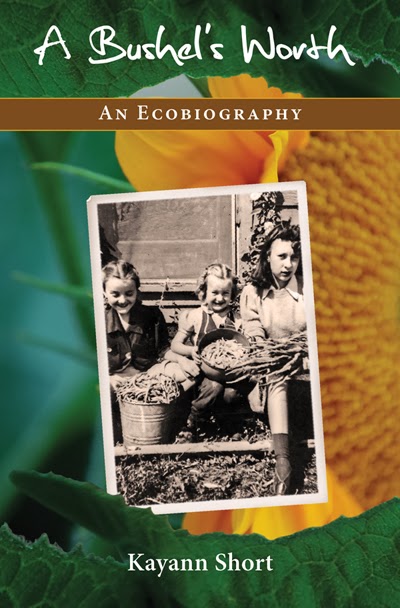
Kayann and her sister Kari (front) at their grandparents' farm.
As I began compiling the bits and pieces of my farming stories in a new draft called Farmroots, I borrowed from digital stories I had created about my great-grandmother’s teaching and farming lives, which now seemed so close to my own. I also drew from blog posts about my two prairie grandmothers, using one of their diaries to describe the weather and land that shaped their day-to-day tasks. I alternated chapters about Stonebridge with North Dakota memories, loosening the seasonal structure and adding photographs and recipes to illustrate the connections between the farms.
Once again, I sent queries to New York agents, who this time
told me that interest in farming had already peaked. One agent even said she’d
gone down to her local bookstore and found a “whole shelf” of farming books. It
seems another farming book would be hard to sell without a national platform, one
I didn’t have.
 A whole shelf of farming books didn’t sound like a lot to
me, but I understand the topical cycles of conventional publishing. I noted,
too, that many of these farming books were about, in the words on one back
cover, urbanites “escaping city ways.” My book was not about escape, but rather
about reunion with my family’s farming past on our own Colorado land. I decided
I needed an independent publisher who understood stories of the West. And
that’s when I found Torrey House, whose mission is “to increase appreciation for the importance
of natural landscape through the power of pen and story.”
A whole shelf of farming books didn’t sound like a lot to
me, but I understand the topical cycles of conventional publishing. I noted,
too, that many of these farming books were about, in the words on one back
cover, urbanites “escaping city ways.” My book was not about escape, but rather
about reunion with my family’s farming past on our own Colorado land. I decided
I needed an independent publisher who understood stories of the West. And
that’s when I found Torrey House, whose mission is “to increase appreciation for the importance
of natural landscape through the power of pen and story.”
As I prepared the manuscript one final time, I brought the
Stonebridge story up to date. Torrey House co-publisher Kirsten Allen urged me
to emphasize some of my concerns about farming. I joked that I didn’t want to
seem too big a worrier, but that last summer finishing the manuscript upped the
worry ante with injury, drought, and wildfire. I strengthened, too, environmental
themes by including my fifth-grade memory of the first Earth Day, childhood
camping trips in the Rockies, and discussion of development pressure along our
foothills corridor with its attendant urgency for local farmland preservation. We
titled the book A Bushel’s Worth
after the chapter about Stonebridge’s instructive attempt to grow wheat. The
subtitle comes from my own idea of “ecobiography” as ecology-based memoir at
the intersection of nature writing and personal narrative.
Writing, like farming, takes persistence, patience, and a
belief in the regenerative power of work, all lessons I surely learned from my
grandparents and from the land itself. The generous support I’ve received from
Women Writing the West members has been a wonderful boost on my journey, as has
the encouragement of friends and family. My path to publication wasn’t easy,
but I kept going until I found my niche.

At readings for A
Bushel’s Worth, I offer this advice: write the stories you want to see in
the world. With all the publishing opportunities today, be open to options that
offer a better fit. Be open, as well, to revision and new ideas about your
writing. Be flexible and welcome feedback, adapting what you need to further
your greater vision. Once your book is in the world, keep listening. Stories
don’t end with a book’s publication. Each reading provides another chance to harvest
the stories we share.
Kayann Short, Ph.D., is the author of A Bushel's Worth: An Ecobiography. She is a writer, farmer, teacher, and activist at Stonebridge Farm, an organic community-supported farm in the Rocky Mountain foothills. Short’s writing has appeared in Pilgrimage Magazine, Colorado Gardener, Redstone Review, Women’s Review of Books, The Bloomsbury Review, Edible Front Range, and various academic journals. Short has taught ecobiography workshops on “Writing the Self in Nature." Read more about Kayann at her website.