Pages

Wednesday, March 05, 2014

Connecting the Past and Present: The age old tradition of Livestock Branding


by Natalie Bright

The alarm clock blasts the silent morning. Time to get cracking, on eggs, that is.  The scene outside my window hides in shades of gray, and I’m thinking about the dugout dating around1895 that established the headquarters of the Sanford Ranch.
The dirt dwelling has endured many transformations through the years as evidenced by crumbling cement, sagging roof, and rusted plumbing. How many countless families and ranch hands have called this crude shelter home? I wonder about the woman who once lived there. Garland Snow Whiteside Sanford would have risen before sunrise, just like me, for spring branding.
She most likely had great dreams of building a life in this place where no one had ever lived before. Arriving as a newlywed in 1901, the original dugout became the back room to a two-story dwelling. Years later the wooden house was destroyed by fire, however the dugout remained and was used for a cowboy bunkhouse.
As I listen to sizzling bacon, I imagine Garland Snow had a cast iron skillet much like mine. I wonder if she was lucky enough to have a wood-fired cook stove, or perhaps she cooked on an open flame.
With spurs jangling, hungry men file past me for breakfast. I realize that time has not changed the fundamental need for the working cowboy. These men really do work from “can see to can’t”. In the pre-dawn light, I watch a frenzy of brushing, saddling and stock trailer loading. Our Ranch Manager wants everyone in their assigned pastures by first light.
The joy of another opportunity to greet the rising sun on horse back shows on the old-timers faces. The younger men are unable to suppress their grins, and the perceptive, skittering horses are anxious as well. In what seems like no time at all, men, horses and cattle will squeeze through a gate into a set of working pens and the peaceful morning will explode with frantic calls of mommas and the answering bawls of their babies.
 The sky dawns bright orange, pink and blue. I figure Mrs. Sanford might have taken a moment to appreciate the stunning site before she washed dishes, stirred beans, and prepared the beef brisket. The menu hasn’t changed much.
As a western writer, it’s important that I strive to help others understand about the rich traditions, the magical land, and the back-breaking labor that  embraces a part of history. Some people might not realize we’re still here. We are. Just over the next rise, at the end of the paved road, this centuries old work continues.

 Let the wilderness drive us forth as wonderers, scatter our broken bones upon these sands…it shall not kill the purpose that brought us here…the dream still lives, it lives…and shall not die.PAUL GREEN


Natalie Bright is an author, blogger, and enjoys speaking about history and story craft. Her stories and articles have appeared in numerous publications, most recently this March “A Cowboy’s Life” will appear in Appleseeds. She is represented by Mr. Stephen Fraser, of The Jennifer DeChiara Literary Agency, NYC, who is currently shopping her western novels for middle grade readers. She holds a BBA from WTSU, her husband is a geologist and cattle rancher, and they have two teenaged boys. She’s on the web at Facebook/Natalie-Bright-Author, Twitter @natNKB, Amazon Author Pages, Pinterest/natbright, her website is http://www.nataliebright.com, and she blogs every Monday at http://wordsmithsix.wordpress.com
 

Wednesday, February 26, 2014

Looking for Fame in All the Wrong Places

by Anne Schroeder

Wow. I’m so happy to be writing this. The event I have been working toward for the past five years is finally happening. I signed a contract with Oak Tree Press for my first historical Western novel. It has a name—Cholama Moon.

 Lucky me, right? Actually, the trail has been long and convoluted. One, I suspect, not unlike a lot of other writers.

Several years ago, I started writing and submitting short stories. I entered a few contests. Won a number of firsts, seconds and honorable mentions. Plastered my office with these atta-boys to inspire me in the dark hours.

One of the contests I entered was a San Joaquin Valley Sisters in Crime competition. I don’t write mystery, but the judge liked my story so much that she awarded it an honorary Coveted Dead Bird award.

I continued to write memoir. First, Branches on the Conejo, then Ordinary Aphrodite, about the Baby Boomer experience sans the drug, sex and rock and roll. Through it all, I wrote novels.

 If asked to define what I wrote, I would say, “I write mainstream women’s inspirational novels with
elements of romance, set in the West.” Agents' eyes would glaze over, but I had a vision.

One year I pitched a manuscript at the Mount Herman Christian Writers conference. The agent asked a fair question: Did I read Christian genre? Um, not really. Francine Rivers, Karen Kingsbury, Mary Connealy—but, then, who doesn’t? A couple of Amish romances. He was not impressed and I had to face the truth that I was never in the game.

 So, ummm, what do you write? (asked the next agent at another conference.) Well, I write women’s fiction. Ahh…(with an encouraging nod,) Romance.

Well, not exactly. That is to say, true love triumphs in the end, but my books are more than two people running towards each other, gauzy shirts flying. I write mainstream women’s inspirational fiction with elements of romance, set in the American West.

Old habits die hard. But I was starting to wonder, what is so hard about this concept?

 Because I love to read them (hmmm, where had I heard that before?) I began writing plain, old-fashioned western stories with strong female protagonists. Bingo! Historical westerns. Nothing more. Implied in the term are the things I didn’t need to say—inspiration, old-fashioned values, a ton of research, a compelling story. A boy and a girl.

Long story short, the mother of the judge who awarded me the Coveted Dead Bird award was now working for Oak Tree Press, who was (happily for me,) bringing out a line of historical westerns. I queried. She remembered my name (and the story.) She fast-tracked me through the submission process. And the rest, as they say, is history.

 But since good luck runs in threes, there’s even more!

I am a member of Women Writing the West. At one of their conferences I won an audio book contract from Books in Motion. At another conference, I entered a short story in the LAURA Short Fiction competition. A few months ago a screenwriter read it and asked for a script. We worked on it together—emailed it back and forth until it shone. Now my little short story, Last Dance, is the script that two mock production companies are developing at a film school in Santa Fe.

Suddenly all the unconnected moves I have made in the past several years turn out to be the right moves. Pretty lucky, you think? But every fiction writer has a mantra posted on their computer: “Publication is a Process, not an event.” 

Please share how your process has evolved. If only as a cautionary tale, like mine.

Read more about Anne and her writing journey on her website and her author blog.

Wednesday, February 19, 2014

February Member News

We have some good, prolific writers in our circle! Congratulations to all!

New Releases


Sheila MacAvoy Block recently published a short memoir, Three Years, in Stickman Review, an e-zine. It's about her experiences together as her husband Robert approached his death.


C.M. Mayo, Metaphysical Odyysey into the Mexican Revolution: Francisco I. Madero and His Secret Book, Spiritist Manual (Dancing Chiva, 2014) In a blend of personal essay and a rendition of deeply researched metaphysical and Mexican history that reads like a novel, award-winning writer and noted literary translator C.M. Mayo provides a rich introduction and the first translation of the secret book by Francisco I. Madero, leader of Mexico's 1910 Revolution and President of Mexico 1911-1913.


Shanna Hatfield Love at the 20-Yard Line (contemporary romance): Brody Jackson lives and breathes football as a wide receiver for an arena team. Focused on his aspirations to make the NFL, he’s blindsided by the love that intercepts his plans during the first game of the season. Possessing all the skills and talent to be the best at his game, Brody isn’t properly equipped for the playing field of romance. It’s going to take all he’s got to score a touchdown with love instead of fumbling his chance at winning one sweet girl’s heart. Successful in business but woefully inept when it comes to men, Haven Haggarty has much to learn. Coached by her outgoing cousin how to pass and receive in the game of love, Haven keeps coming up short of the goal line. Falling for the local arena football team’s handsome wide receiver, Haven realizes she needs to tackle her fears or lose a future with the man of her dreams.


Shanna Hatfield Fifty Dates with Captain Cavedweller (non-fiction relationship) Waking up one day to discover they’d gone from perpetual honeymooners to a boring, predictable couple, author Shanna Hatfield and her beloved husband, Captain Cavedweller, set out on a yearlong adventure to add a little zing to their relationship. This G-rated journey through fifty of their dates provides an insightful, humorous look at the effort they made to infuse their marriage with laughter, love, and gratitude while reconnecting on a new, heartfelt level.


Susan Wittig Albert announces the Kindle publication of her book Starting Points, a collection of writing prompts for women. She created the book for Story Circle Network, the women’s writing organization she founded in 1997.


Awards

Sheila MacAvoy Block’s short story, “Blackbird”, has been nominated for a Pushcart Prize. That story is up on the e-zine Midway Review.

Wednesday, February 12, 2014

The Key to Indexing

by Amron Gravett

Are you a nonfiction author tasked with creating an index for your soon-to-be published book? These five FAQs will help you understand what an index is, why you need one, and help you with your next steps in the process.

1. What is an index?
“An index is a structured sequence—resulting from a thorough and complete analysis of text—of synthesized access points to all the information contained in the text. The structured arrangement of the index enables users to locate information efficiently.” (Mulvany, Indexing Books, 8). In traditional publishing, an index is found in the back of a nonfiction book. A good index is accurate, concise and provides complete coverage of the book’s information. The structure of the index is created by a coherent web of synonyms, main and subheadings, double postings, and cross-references.

2. Do I really need an index?
Absolutely. If you are publishing a nonfiction book (such as a biography, history, memoir or reference book) without an index, then your book lacks one of the most important reference and sales tools available. A nonfiction reader is looking for information. It is true that a majority of nonfiction readers will browse the index before deciding whether they want to buy the book. They will look for key ideas, persons, topics, etc., that interest them and if there is no index, they will not be able to do this and thus will reconsider buying the book.

3. Do authors index their their own books?
Ideally, no. Although the author is the expert on their topic, the indexer reads the manuscript with reader’s eyes understanding information architecture, retrieval techniques and indexing standards. An index is created using a marriage of the author’s and the reader’s language.

4. Does an indexer read the whole book?
Absolutely. A quality index cannot be created without a thorough reading. I usually do a word by word reading the first pass while I create the initial draft of the index. Then, I speed read the manuscript once or twice, during the editing phase to create the final index. This ensures that I have not missed any of the important information or connections that are made throughout the manuscript.

5. How do I find a professional indexer?
One of the best and easiest tools for locating a professional indexer is to search the American Society for Indexing, Indexer Locator. 
Other professional organizations that profile indexers include:
Editorial Freelancers Association Find a Freelancer,  
Rocky Mountain Publishing Professionals Guild Directory, Society for Technical Communication Job Bank.

Fun fact: The plural form of index is indexes, not indices. For more information, go to:
http://www.asindexing.org 

Amron Gravett is a professional indexer, librarian, member of Women Writing the West and this year’s WILLA Coordinator for Scholarly Nonfiction. She can be found at Wild Clover Book Services or her website.http://www.AmronGravett.com 

Wednesday, February 05, 2014

Why Book Covers are So Important

by Shanna Hatfield 

Many scoff at that adage of not judging a book by its cover, but the harsh truth is that people judge books by their covers every minute of every day.

That’s why it is so, so important for book covers to stand out from the crowd – in a good way.

First, let me state that I am not an expert on book covers. Not at all.

However, I have learned a few things in the last two years of self-publishing about book covers and thought I’d share them with you today.

Your book cover should provide, at a glance, some hint about your story. People should be able to look at your cover and see a tiny preview into the book.

If you’re writing a flowery romance that’s all sunshine and roses, you wouldn’t slap a photo of death and destruction on the cover. Likewise, if your book is a dark, suspense thriller, you wouldn’t make the cover all happy and cheery. Your cover should set the tone for the book. Similarly, it’s helpful if your cover image reflects the content of your book.

If your book is set in the mid-1800s in a western town, you wouldn’t put a photo of a skyscraper on the cover. The image should allude to the story.

The next step is one I think many people forget to take into consideration when they are choosing a book cover. Picture your cover the size of a postage stamp. That is close to the size your book appears in on-line retailers. Can readers clearly see the image? The title? Your name?

While a cover may look great filling your computer screen at full resolution, when you get it down to that tiny little size, it may lose all the important detail.

It is tempting for authors just getting started to cut costs by slapping together something for a cover. Resist that urge with every fiber of your being. If you don’t have graphic design skills or resources, hire someone who does to design your cover. You want your book cover to look professional and polished.

Avoid purchasing a popular pre-made book cover. I’ve noticed, especially during the holiday season,
you can easily find the same cover on a dozen different books in a quick look through online offerings. When a reader is browsing through sea of identical covers, there’s a strong chance they won’t choose any of the books. Stand out from the crowd with something unique. There are many talented graphic artists working for reasonable fees.

You absolutely want your book cover to be an original. Invest time, funds, or effort into making it the very best cover possible.

Your book deserves it and so do you.

Shanna Hatfield is a hopeless romantic with a bit of sarcasm thrown in for good measure. In addition to blogging, eating too much chocolate, and being smitten with Captain Cavedweller, she writes clean romantic fiction with a healthy dose of humor. She is a member of Western Writers of America, Women Writing the West, and Romance Writers of America. Find Shanna’s books and follow her online: ShannaHatfield

Wednesday, January 29, 2014

Chasing Bierstadt, Stegner, and Abbey

by Kristen Lodge

After finishing college in New Hampshire, in 1999 I moved to my first mountain town near Bethel, Maine. I started writing my stories that eventually became Continental Quotient Stories From Both Sides of the Divide. My stories are about place and landscape, and how I found new adventures and met amazing friends across the US.

Since high school I wanted to be a westerner. Back then, to me, being western meant big landscapes with less people and more wildlife. I began to read Wallace Stegner and Edward Abbey and dreamed of living west of the Mississippi. I discovered the western landscape paintings of Albert Bierstadt.

Colorado Blue Sky

I wanted to live in those wide open spaces they wrote about. I wanted to ski in western powder. I finally moved west in 2004 and continued to write the stories for Continental Quotient. One of my favorite stories to tell is about driving I-70 through Ohio, Kansas and into Colorado. The story of my journey west and my first western town becomes “Making A Home Out West.” I write about making friends and finding new adventures in Colorado that include hiking and biking. Steamboat was my first western ski town and I instantly fell in love with the Yampa Valley and the ski mountain.

What it means to be western has evolved over the last ten years. At first it was big landscapes. Then it was the blue, blue sky. Being a westerner and choosing to live in an arid landscape has become an education about water and protecting wild places. And now, after ten years living in the west, I’ve learned it is about taking care of each other and making a home wherever I live.

Fraser, CO

I am in love with mountain landscapes and currently am falling in love with the southwest desert.

The stories I love to tell are about taking every adventure that comes my way from living in a mountain town surrounded by wilderness to navigating through the prickly, Saguaro filled desert landscape. I re-read Stegner and Abbey every chance I get and still search for Bierstadt in western museums.

Continental Quotient is available for purchase on Amazon.comhttp://www.amazon.com/Continental-Quotient-Kristen-Lodge/dp/1938846125 or Barnes and Noble.com and Homebound Publications website. It is available on Nook and Kindle.  Please visit Kristen's website for more information about the book and upcoming speaking engagements. Kristen blogs at My Outdoor Blog.

Kristen grew up in Plattsburgh, New York and Rye, New Hampshire. She earned a BA in English from the University of New Hampshire. Her collection of creative nonfiction was published in October 2013 by Homebound Publications. She lives in Tucson, AZ with her two dogs: Daisy & Winnie. 

 Naranja Park near Tucson, AZ

Wednesday, January 22, 2014

January Member News

We have an impressive list of new releases and recognition this month! 

New Releases
Irene Bennett Brown Chaff ’n’ Chatter This collection is her “sort of memoir” of the times. "Take a snippet of history, a tad of nostalgia, priceless photos, several small town delights (like mint princesses and the benefits of a back yard where kids imaginations turn old wagons into stage coaches). Put them together with quotes from Byron and Emerson and a few other poets in just the right measure and you'll savor insight and wisdom across the years and generations. You'll also be holding in your hands another Irene Bennett Brown classic. Chaff 'n' Chatter is a writer's research tool, inspiration and just plain good reading. I confess to a bit of the green-eyed envy that this award-winning writer has been writing this well since the 1960s. She must have come out of the womb with well-spoken words. How fortunate we all are that she's saved them and chosen to share them now in this wonderful collection of essays I'll treasure." Jane Kirkpatrick, New York Times Bestselling author of Homestead, A Memoir.


Sherry Monahan, Mrs. Earp When most people hear the name Earp, they think of Wyatt, Virgil, Morgan, and sometimes the lesser known James and Warren. While it’s true these men made history on their own, they all had a Mrs. Earp behind them—some more than one. Mrs. Earp collectively traces the lives of the women who shared the title of Mrs. Earp either by name or relationship.


Susan Wittig Albert has announced the re-release, under her own imprint Persevero Press, of two books previously published by Jeremy Tarcher: Work of Her Own: A Woman’s Guide to Creating Her Own Livelihood and Writing From Life: For Women With Stories to Tell. Both are available in eBook and print formats, online. 


Tammy Hinton, Retribution. The war changed everything Emilee loved. The young woman couldn’t foresee the terror that peace would bring. Moving to Texas seemed the answer, but Death rode the same trail west. Emilee vowed she’d deliver the villain to the hanging tree or put a bullet in him herself.


 Hearts and Spurs Two WWW members have stories in this anthology (first and last in the volume, respectively):
 "The Widow's Heart" by Linda Broday Desperate and alone, Skye O'Rourke finds courage and a love she thought she'd lost when a man from her past emerges from the shimmering desert heat.
 "The Second-Best Ranger in Texas" by Kathleen Rice Adams A washed-up Texas Ranger. A failed nun with a violent past. A love that will redeem them both.( How do you capture a cowboy's heart?
Nine of western romance's best authors come together in one volume to help Old West heroes and heroines find their happily-ever-afters. From mild to sensuous, from outlaws to lawmen, from sassy nuns to saucy mail-order brides and tough-as-nails widows, Hearts and Spurs leaves no doubt that when Cupid plays with cowboys, he plays for keeps.  The book is available in paperback at Amazon and in most e-formats at your favorite online bookstore (Amazon, Smashwords, Kobo, Barnes & Noble, and others).


Althea Williams Clay's Quest, under the pseudonym, Christi Williams. She’ll do anything to get her way. Tall, elegant and beautiful, Emma Thorpe has wanted a baby for years. The yearning for a child occupies all her thoughts, her time, her effort, and any money she and her husband can scrape up for medical intervention. After trying and failing to conceive, the solution that finally comes to her is to leave her husband and hope to find a man—any man—capable of fulfilling her deepest desire. Also available on Kindle and Smashwords.


Gail Jenner, Across the Sweetgrass Hills, a previous WILLA Award winner, has been re-released by Prairie Rose Publications. Liza Ralston has had more adventure in her life than she ever wanted. Leaving her settled existence with friends and family in St. Louis to travel to the Big Sky country of wild Montana with her father, she soon wishes she could turn the clock back. When their scout is murdered and her father is severely wounded by thieves, the Pikuni tribe led by Crying Wind takes them in. But Liza wants nothing more than to return to St. Louis, despite her growing attraction for Red Eagle, the handsome son of a white trapper and Blackfeet mother.


Awards

Barbara Marriott The Fleet Angels of Lakehurst won the silver medal in the national military book contest sponsored by Stars and Flags. This book is the history of one of the United States Navy's first helicopter squadron. With oral histories and official documentation, the story of their missions, from the mundane to the heroic saving of lives, is told. Woven throughout is some of the quirky humor that got them through many difficult and dangerous times.


Sandra Ramos O'Briant The Sandoval Sisters' Secret of Old Blood won First Place Historical Fiction and Best First Book at the fifteenth annual ILBA (Junot Diaz, a Pulitzer winner headed the list) held in NYC , and was included in another top 10 list of Latino Stories in 2013. (This one headed by Sonia Sotomayor). The book was also named to a top 10 list by TheLatinoAuthor.com in 2012, the year it was published. It was reviewed by La Bloga  and by Dawn Wink on Storycircle.

Wednesday, January 15, 2014

But Now I Ride

by Amy Hale Auker

At Cottonwood Spring, there is a tree that sings. Sometimes it is a squeaky gate, sometimes a flute, sometimes a soprano warming up her voice. I am sitting on my horse here in the creek bed, waiting, holding a few cows against the fence until the boss, my husband, comes along with more. I may be here for a while.

When a woman hires on to cowboy, these are not the moments she anticipates, not the moments anyone talks about. There are no witnesses, no cameras, no glitter, no wild rides with her hair blowing in the wind.

There is no printed job description for “cowgirl.”

A few months ago, I passed out a survey to a handful of women who have cowboyed for a paycheck. I was not surprised to discover that most of them didn’t have a strong affinity for the word cowgirl. Many of them cited semantics or wryly wrote something about rodeo queens. These women more often think of themselves as cowboys or ranch hands, or simply ranch women.

But no matter what we call ourselves, we are out here.

We are riding. And digging postholes. Tying in stays. Calving heifers, haying, windmilling ... often with a toddler in tow.We are cooking over a campfire or in a slow cooker, even after having brought in our share of the cows that day. We’re training young horses. Doctoring sick animals. We’re riding point or bringing up the drag. We may even be complaining about how Western jeans aren’t made of heavy enough denim anymore, and we won’t buy a pair with bling on the back pockets when we have to ride on them for nine hours a day.

Our gear and tack look much like the men’s except for the rubies on the buckle of our chaps. We own several pairs of work gloves, and we can pull a knife out of our pocket or off our belt if we need to, even when we are all dressed up, attending some event in town. We can kill a rattlesnake. Fix a water leak and plant a garden. Maybe shoe a horse.

Some women were born into this way of life....

Read the rest of this article in Cowboys & Indians magazine.

Amy Hale Auker is an award-winning cowgirl poet and author of Rightful Place. Her new novel, Winter of Beauty, is available at Amazon.com and www.pen-l.comhttp://ww.pen-l.com. For more information, visit www.amyhaleauker.comhttp://www.amyhaleauker.com.
 

Friday, January 10, 2014

Costco Book Signing Part 2

by Gail L. Jenner

Unfortunately, this year's first signing arranged at the Roseburg, Oregon, Costco for the Christmas season had to be cancelled because of deep snow and ice. Interstate 5 was closed and I ended up getting stuck in Ashland, Oregon, overnight. I immediately called both Costco and Arcadia to update them.....then eagerly suggested I return the next week or whenever (as it turned out, the next week was again hit hard by ice and deep, cold temps). I didn't want to let any time lapse before getting a commitment from both Arcadia and Costco!

 A week later, when I finally arrived at Costco in Roseburg -- after a slip-slippery trip north over three mountain passes -- the very busy Costco manager met me, assuring me that he was impressed by my perseverance. He also noted that a couple of authors they'd lined up had refused to make the trip in winter again. For me it was a roundtrip of about 7 hours (in good weather), but it didn't matter! Knowing that Costco purchases at least 75 books if they're arranging a signing, I had to go. Last year I was fortunate to do the Roseburg Costco signing with Diane Gardner (WWW member and awesome author!). Not only did she allow me to stay the night with her and her husband, but we spent a wonderful afternoon together signing books (unfortunately this year she had to miss the signing). Fortunately, I sold almost 30 books in this year's 3 hour signing AND also signed all remaining books Costco had ordered.

One of the lessons every author needs to learn is that books to be sold, IF autographed, are "as good as sold" for the author. Don't let any of them go unsigned!

All of this suggests that any author hoping to arrange a successful signing, whether small or large, must:
1. Be willing to go wherever she's asked!
2. Be available and assertive in making contact and maintaining communication, not "waiting" for others to contact her.
3. Arrive on time and with energy and enthusiasm.....I even brought additional posters and marketing postcards, etc., with me this year, which the Costco manager appreciated (esp. since my original signing had been postponed and not as much "in-store" publicity was available).
4. Encourage whatever publicity agents she's attached to to seek out more opportunities...assuring her that she can/will promote the signing through news items, radio interviews, and social media outlets.


One last lesson that I took to heart THIS year was this: 

Be assertive with the patrons. Costco is an enormous store and many people do not approach an author, thinking that she is possibly one of those store sales people!
So put up your own sign: MEET THE AUTHOR!
Stand (don't sit) behind the table Costco provides. I enthusiastically greeted people passing by....sometimes asking, "Have you heard of the State of Jefferson" (because the "issue" of the State of Jefferson has been in the news lately, many people stopped and smiled, sometimes asking their own questions)?
Provide postcards/collateral with every book sold and place it for easy access on the table. I put up small easels where I could prop my books, too, since people in Costco often move quickly up and down the aisles. Making the books visible from many angles is important.
Connect with the manager and be sure and thank him/her for all help. And send notes or emails to thank those publicity people who helped arrange your signing. They do not get enough credit for the work they do.

All in all, I am tremendously grateful to Arcadia and its sales/publicity departments for their continued support. A publicist has a tough job to do and appreciates the enthusiastic support an author can give her/him.

Though I can't guarantee a Costco signing, I do believe signings (however limited) are important. The author is any book's best and principal sales tool, so we need to cultivate a visible and enthusiastic persona. With each signing I have gained more confidence and enthusiasm, even though I'd rather be tucked away in my upstairs office -- overlooking my garden and the ranch -- working on my newest piece of writing!


Gail L. Jenner is a Past President and Willa Chair of Women Writing the West. She has written seven books, including WILLA award winning Across the Sweet Grass Hills, and has written articles for numerous magazines. She is the wife of a fourth generation cattle rancher and lives on the family's historic farmstead. For more about Gail and her writing, visit: www.gailjenner.com.


Wednesday, January 08, 2014

Hard Work Pays Off in Costco Signing

by Gail Jenner

Getting a good book signing organized is hard work. I am not an aggressive marketer by nature, but I'm learning that most success is based on successful marketing!! Women Writing the West members have taught me much of what I've learned in regards to marketing over the last 14 years I've been a member; that's one important reason why attending conferences and connecting with other authors is so important. I'm supremely grateful to WWW for the contacts and awesome friendships I've made.

As with most authors, I've done a number of book signings -- from small, local bookstores and county fairs to Barnes & Noble and Costco! I'm fortunate that I have now had four signings at two different Costco stores in the last three years. In reality, I had little to do with the Costco signings; it was my publisher, Arcadia Publishing, who originally arranged them. I would note, however, that most Costco stores support the idea of promoting local books so approaching them even if your publisher hasn't done so is well worth the effort. But I do believe that my energetic responses to Arcadia's initial efforts has led to my repeated signings.

 First of all, when I signed contracts with Arcadia Publishing for the four various books I've done with them, I agreed to do any book signings. In my mind, I have always added, "regardless of the miles I must travel to get there!" I recognized that I owed the stores selling my book any amount of time and energy to promote it. So when the publicity department of Arcadia contacted me about the first possible Costco signing three years ago, I immediately responded. I also continually kept them in the communication "loop," which I have since learned is a trait many authors do not cultivate. In fact, just recently my Arcadia publicist told me that I had helped her immensely, saving her the trouble of having to make contact with me -- whether it was about double-checking arrangements or responding with requested information, etc.

 A simple lesson, perhaps, but every author needs to answer emails promptly in addition to following up on dates, places, and directions, or writing thank yous, etc... I also created/submitted local news items for the paper and every FB/social outlet I could access, and I contacted our radio station and arranged an interview.

As it has turned out, two different Costco stores have arranged signings for my State of Jefferson books in the last 3 years. I know the subject matter is part of the reason for their continued interest. Both Southern Oregon and Northern California are part of the "mythical State of Jefferson" thus the attraction is fairly widespread. While tourists and history buffs enjoy most Arcadia's titles, these particular titles have attracted even more attention. I've now coauthored four different books for Arcadia, including three on the State of Jefferson: Images of the State of Jefferson; The State of Jefferson: Then & Now -- which placed as a Finalist in the 2008 Next Generation Indie Awards; and Postcards From the State of Jefferson.

Read Part 2 of Gail's experience with signing books at Costco and her adventures in getting there on this blog tomorrow.

Gail L. Jenner is a Past President and Willa Chair of Women Writing the West.She has written seven books, including WILLA award winning Across the Sweet Grass Hills, and has written articles for numerous magazines. She is the wife of a fourth generation cattle rancher and lives on the family's historic farmstead. For more about Gail and her writing, visit: www.gailjenner.com.

Wednesday, December 18, 2013

December Member News

Congratulations to all our WWW members for their awards and new publications! Head on over to WWW Member Newshttp://www.womenwritingthewest.blogspot.com/p/www-news.html to get the latest scoop on the newly published and the winners.

Monday, December 16, 2013

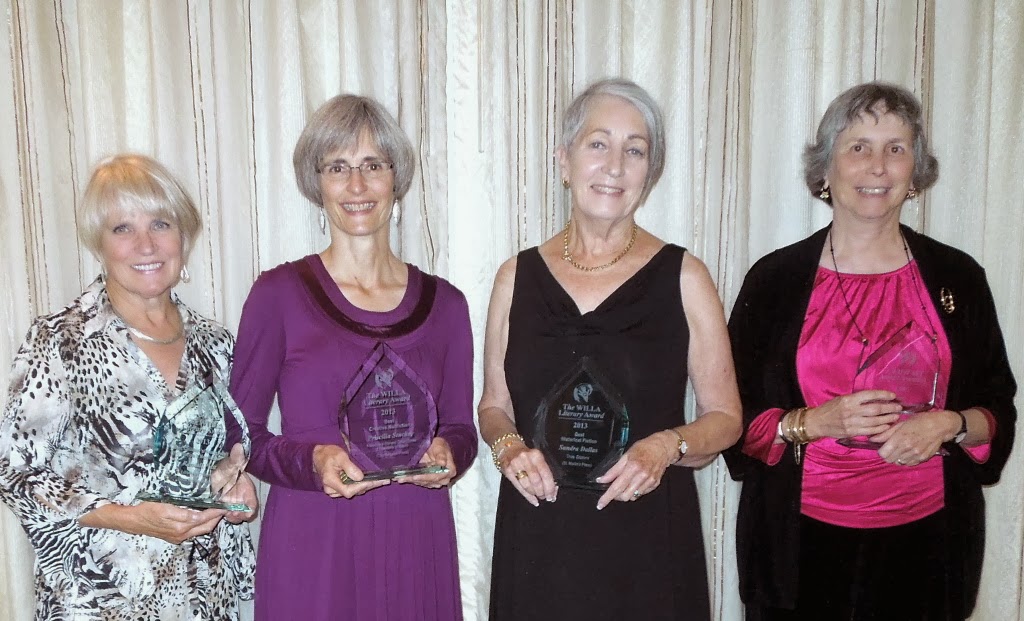
WWW Honors Books, Authors with its WILLA Awards

 2013 WILLA Winners in Attendance

by Pamela Tartaglio
Women Writing the West honored the recipients of its 15th Annual WILLA Literary Awards at the WWW conference in Kansas City, Missouri. These books, listed below, represent the best of 2012 published literature featuring women’s or girls’ stories set in the West and include fiction, nonfiction, poetry, children’s/YA.

“Fascinating, excellent, gripping, engaging, wonderful,” are some of the words the professional librarian judges wrote about the Winning and Finalist books. A number of the winning authors traveled to Kansas City to accept their awards at the October 12 Finalist Luncheon and the evening WILLA Banquet, where each Winner was presented with a crystal trophy and $100. The ceremonies, at which every title is recognized with comments written by the librarian judges, are highlights of each year’s WWW conference.

The recipients of the 2013 WILLA Literary Awards are as follows:

CONTEMPORARY FICTION 
WINNER: Theft by BK Loren (Counterpoint Press)
FINALIST: A Growing Season by Sue Boggio and Mare Pearl (University of New Mexico Press)

HISTORICAL FICTION
WINNER: True Sisters by Sandra Dallas (St. Martin’s Press)
FINALIST: Tributary by Barbara K. Richardson (Torrey House Press)
FINALIST: Dance with a Gunfighter by Joanne Pence (Quail Hill Publishing)

ORIGINAL SOFTCOVER FICTION 
WINNER: The Bones and the Book by Jane Isenberg (Oconee Spirit Press)
FINALIST: In Need of a Good Wife by Kelly O’Connor McNees (Berkley/Penguin)
FINALIST: The House on Swiss Avenue by Irene Sandell (Eakin Press)

CREATIVE NONFICTION
WINNER: Kissed by a Fox and Other Stories of Friendship in Nature by Priscilla Stuckey (Counterpoint Press)

SCHOLARLY NONFICTION
WINNER: Women in Wonderland: Lives, Legends and Legacies of Yellowstone National Park by Elizabeth A. Watry (Riverbend Publishing)
FINALIST: Divinely Guided: The California Work of the Women’s National Indian Association by Valerie Sherer Mathes (Texas Tech University Press)
FINALIST: Colorado Women: A History by Gail M. Beaton (University Press of Colorado)

POETRY
WINNER: Steam Laundry by Nicole Stellon O’Donnell (Red Hen Press)
FINALIST: Reluctant Traveler by Laurie Wagner Buyer (Seven Oaks Publishing)

CHILDREN’S/YOUNG ADULT FICTION & NONFICTION 
WINNER: Liberty’s Christmas by Randall Platt (Texas Tech University Press)
FINALIST: The Quilt Walk by Sandra Dallas (Sleeping Bear Press)
FINALIST: Outcasts of River Falls by Jacqueline Guest (Coteau Books)

 2013 WILLA Finalists in Attendance and WILLA Chair

 WWW is now seeking entries from authors or publishers for the 2014 WILLA Literary Awards, which will honor books published in 2013. The deadline for submission is February 1, 2014. For 2014 Guidelines and Application, visit www.WomenWritingtheWest.org or write Women Writing the West, 8547 E. Arapahoe Road #J-541, Greenwood Village, Colorado 80112.

The award is named in honor of Pulitzer Prize-winner Willa Cather, one of the country’s foremost novelists.

Pamela Tartaglio, 2013 WILLA Chair/Past President, was delighted to read aloud the comments from the librarian judges and hand trophies and plaques to the authors.

Wednesday, December 11, 2013

Finding Gold

by Doris McCraw 

In 1848 gold was found in California. Although there had been some placer gold found in the southeast, this was a game changer. When word arrived back east of the Mississippi the rush was on. Unfortunately many of the thousands who sailed around the southern tip of South America, crossed at Panama or traveled across country in wagons and carts failed to find enduring riches.

Then in 1859 another rush was on. There was gold found in Colorado and many who had missed the first rush headed west across the Great American Desert with Pike's Peak or Bust painted on their wagons. From 1859 on gold was found in most of the Western states, the Dakotas, Nevada, Montana, etc. The last rush was in the 1890′s in the Cripple Creek region of Colorado and in the Alaskan territory. Many people followed one rush after another, most to no avail.

In looking at the pattern, so many rushed over true wealth. In California some of the pristine areas were forever blighted. The Great American Desert was in reality part of the breadbasket of the nation. Forest, mountains, rivers all were all sacrificed to the need for quick wealth.

The quick wealth was another matter altogether. Some miners found gold nuggets just lying around, but most prospectors and miners worked hard, long hours and barely broke even. In the long run it was those who supplied the gold seekers, or processed the gold ore that won the prize.

Perhaps you are wondering why the history lesson. For me it is the lessons learned that make it worthwhile. Many times we search for the quick answer and the bonanza strike of gold in our lives and work. We dream of bestselling books, an easier life and more money. Those dreams can definitely come true. The thing we need to watch for; not rushing by and missing the true gold. Friends,family, home are the true gold. In our rush to find gold, savor the journey and those we share it with. In the end, they will be the ones who help us find our own gold.
written and copyrighted by Doris McCraw  http://renawomyn.blogspot.com/

Wednesday, December 04, 2013

A Wilder Rose Goes to the Library

by Susan Wittig Albert

I’ve been writing traditionally-published fiction and nonfiction for nearly three decades. But this year, I decided to publish a stand-alone novel—A Wilder Rose—under my own imprint, Persevero Press. All things considered, I’m glad I chose to take this route, but there have been bumps. A few potholes. Big trees across the road. Getting the book into libraries, for example.

A Wilder Rose is a biographical/historical novel about the collaboration of Rose Wilder Lane and Laura Ingalls Wilder in the writing of the award-winning children’s series, the Little House books. Since most libraries have copies of Little House in the Big Woods and the other seven books in this pioneer series, I had the idea that a book about the Little House books might be a pretty strong candidate for library acquisition. I decided to try to get A Wilder Rose into libraries.

But I ran into a few roadblocks, and I learned that even libraries that might want an author-published book may find it difficult to purchase it. If you’d like to see your book in the libraries, here are some things to consider:

1. Of course, you’ve already seen to it that your book is absolutely the best work you can produce—well-written, edited and copy-edited, and with a professionally-designed cover. It should also have a standard copyright page that lists your publishing information, including the ISBN number. As well, libraries prefer books that have a CIP-data block: a Cataloging-in-Progress data block that makes cataloguing your book easier. The Library of Congress produces this for publishers, but not for self-publishers. However, you can obtain a CIP-data block from a vendor. (I did.) Joel Friedlander has posted a good discussion of this process, along with helpful links. http://www.thebookdesigner.com/2010/03/cip-what-it-means-how-to-read-it-who-should-get-it/

2. Your hardcover book needs a sturdy binding, but it doesn’t need a dust cover. A case laminate cover is excellent. (Here’s Joel Friedlander again, explaining.) Libraries also buy paperbacks and trade paper editions, which they may rebind. But again, make sure the binding is sturdy.

3. Public libraries almost always prefer to buy from their usual distributors: Baker & Taylor and Ingram. I chose Lightning Source as the print-on-demand (POD) supplier for the library edition of A Wilder Rose, because Lightning Source distributes books through both Baker & Taylor and Ingram. Libraries may be more likely to buy your author-published book if you offer the standard institutional discount, 30-40%.

4. Before libraries can acquire your book, you have to let them know it’s available and entice them to order it. For this, you’ll want a press release (print or digital). It should describe your book in beguiling terms and (of course) feature your cover. Mention appealing extras such as index, photos, resource list and/or bibliography. Describe the book’s binding and be sure to include ordering information. One librarian told me to put all of this all on one side of a 9x12 page, or on a postcard. Several librarians reported that they did not want emailed releases.

5. I bought a mailing list of public libraries that serve populations over 40,000. I mailed postcards advertising the book to the 1284 libraries on that list. I have also taken advantage of the mailing services offered through the Independent Book Publishers Association (As a member of this organization, I have used several of its marketing programs. The staff is very helpful.)

6. Consider placing your book on NetGalley. I’m told that librarians often preview books there. I posted A Wilder Rose on NetGalley in July and the book is still being downloaded by reviewers, including librarians.

7. Librarians would like to see a review of your author-published book in at least one of four major review venues: Booklist, Library Journal, Kirkus, and Publishers Weekly. Of the four, only Kirkus and Publishers Weekly offer reviews to self-publishers and indie authors—for a fee. Uncertain whether you should pay for a review? Read Susan Gottfried’s helpful post on assessing the value of paid reviews. I took advantage of both the Kirkus and PW indie programs and earned starred reviews from both. The Kirkus starred review led to two feature articles (one in September, the other in November) in Kirkus’ print and online publications—coverage I wouldn’t have had without the review and definitely worth the up-front investment.

8. On your book’s website, offer resources for libraries, to tweak their interest. You can take a look at what I’m offering here.

9. Your local library may be a good place to begin your marketing efforts, with an offer to talk to library patrons or a Friends’ group about your book. And don’t overlook your state library association. I’ve given talks to three groups of Texas librarians since the publication of Rose, and have been invited to talk (and sell books!) at the Texas Library Association conference in April, 2014.

I’ve found a way to measure the success of these efforts: the number of libraries that are acquiring Rose. I’m keeping track via WorldCat, which lists the holdings of more than 10,000 libraries around the world. As of the day I wrote this post, 159 libraries had ordered or already shelved one or more copies of the book. (Some large library systems have ordered a copy for every branch.) And since only about a third of U.S. libraries belong to WorldCat, it’s reasonable to suppose that Rose is already on the shelves of quite a few more libraries—and that the numbers will continue to grow.


These are the strategies that have worked for me—but I’ll bet there are others I haven’t tried. And of course, library technologies are changing as fast as the publishing industry. I haven’t even thought about trying to get the eBook edition of ROSE into libraries, for example. That a whole ‘nother kettle of fish!

If you’ve had experience in getting your books into libraries, please share. The more we know, the easier this will be—or at least, so we hope!

First written by Susan Wittig Albert for Blood Red Pencil 

"If you loved Laura Ingalls Wilder’s Little House books about her pioneer childhood, you should read A Wilder Rose by Susan Wittig Albert. If you are reluctant to believe that Laura’s daughter Rose may have written the books, you must read this novel...." Linda Hasselstrom 

Wednesday, November 13, 2013

Wednesday, November 06, 2013

Post-Conference Flowers


After the writers’ conference I sat in the sun in the Kaufmann Memorial gardens off the plaza near the Embassy Suites. It is a private spot for introspection among nature and sculpture. I especially noticed the dahlias and fall reedy plants. When I came home I enjoyed seeing my "cutting" garden in front, the Christmas present from my horticultural daughter last year.

Another day I walked at our local Arboretum. Once again in the beautiful fall splendor, I loved the dahlias.

Today, searching through some family photographs, I ran across one that had a sign on a fence stating "Stover Dahlia Gardens." That was news to me.

My great aunt married into the Stover family in Hagerstown, Maryland. Her four sisters thought it was wonderful to have her banker husband in the family. I inherited some items of their rich life style: monogrammed silver, fine linens, a tatted holder for calling cards, and photo stick pins of both Aunt Ora (Knepper) and Uncle Ira Stover.


I didn't know Uncle Ira’s family also gardened, but my subconscious must have. It took about fifty years for that fact to surface. How many more tidbits of coincidences are waiting up there to be released?

Rubbing elbows with the Wonderful Western Women Writers always releases my creativity...again. I can’t wait for what will be revealed after next year’s conference. Sooner than that, I must remember to put dahlias on my Christmas list!

Whether living on the east coast, along the Rockies, or now in the Heartland, Betty pays attention to life and her surroundings. She observes, notates, remembers, and then writes. Currently she’s publishing Tamika and Friends, a children’s historical fiction book about Ancestral Puebloans in the 13th century.