Pages

Showing posts with label Art. Show all posts

Tuesday, October 30, 2012

California History – Natural Beauty Preserved in Art


Around 1900, people stepping off ships near Los Angeles were in luck they arrived in springtime.  They could see, forty miles north, fields of California poppies shimmering orange in the sunshine, on a gentle slope rising above Pasadena and just below mountains.  The poppy fields of Altadena were developed into homes after World War II, when the population surged.  Before that, California impressionist painter Benjamin Brown captured the grass and flowers in Poppies Near Pasadena. 

Paradise Found: The Beauty and Grandeur of California, a recent exhibit at the Irvine Museum, is a reminder of a region with few people, lots of sun, and pastoral hills and rugged seashores.   Benjamin Brown painted this untitled landscape as well as the one above. 

Benjamin Brown and other California impressionists were supported by Eva Scott Fenyes (1849 – 1930), who spent winters in her home on Pasadena’s Millionaires’ Row.  Recognizing that artists need money to continue to create their art, Eva and her husband, Dr. Adalbert Fenyes, not only hired models, gave supplies to artists, and allowed the occasional artist to live on their estate, they added a studio onto their mansion for the artists to use.  Here’s a photo of their Pasadena home, a 1906 Beaux Arts mansion.  On the right is the studio, with an arched glass ceiling to let in natural light.

Pasadena millionaires sought invitations to Eva’s salons, held in the studio.  To introduce California impressionist painters to the wealthy, Eva provided the party – she hired actors to perform plays, as well as musicians and lecturers.  

Eva’s mansion, part of the Pasadena Museum of History, has been renovated and will reopen on Dec. 7, 2012.  Fully furnished, it also houses Eva’s art collection, including stunning portraits of family members and landscapes depicting a Far West paradise.

“Past and Present with Pamela” is a blog celebrating the arts, history, and places.  http://www.PastAndPresentWithPamela.com.  View the recent series of posts about the historic, seaside Hotel del Coronado, the location of the #1 comedy of all time (view a film clip), playground of movie stars and heads of state, and why the stories of ghost sightings would not go away and what the hotel is doing about it.  Pamela Tartaglio, 2013 Past President of Women Writing the West, is writing a novel set in the 1890s in “the world’s greatest gold camp,” Cripple Creek, Colorado, and she volunteers at the Pasadena Museum of History.  She does have one leg in this century --for a very short published story set in the present, see http://www.everydayfiction.com/photocopies-by-pamela-tartaglio/.

Tuesday, October 02, 2012

Stumbling on Family Stories


“In my family, we don’t tell stories. We are reserved and refrain from either gossip or boasting, in part because of our northern European heritage with its inherent emotional reticence.... The result is a family lore as depauperate as forest on exposed granite; stories—like plants—struggle to sprout on its meager soil.”

I wrote those words in my memoir Walking Nature Home to illustrate a challenge in finding my writing voice: I know little about the people I come from.

The Big Sur Coast, by my great-grandmother, Jennie Cannon

The stories I know come mostly from photographs and the artifacts salvaged from my grandparents’ houses, including my great-grandmother Jennie’s impressionist landscape paintings, and copies of scientific papers written by her husband, my botanist great-granddad, who studied deserts the world around.
 
Recently, I visited Berkeley, California, on a hunt for stories in the neighborhood where my mom grew up, including the UC-Berkeley campus, where my parents met in college.
 

The top of the campanile from La Vereda Road


I wound my way up steep, narrow, and switchbacking streets, to the address in the north Berkeley Hills I had found for my botanist and artist great-grandparents.

I recognized the place; I had walked there decades before with my granddad. Through a gap in the trees across the road, I spotted the iconic UC-Berkeley campanile (a tall bell tower).

 A man stood on the porch of my great-grandparents’ house. On impulse, I asked, “Do you live here?”

 He turned.

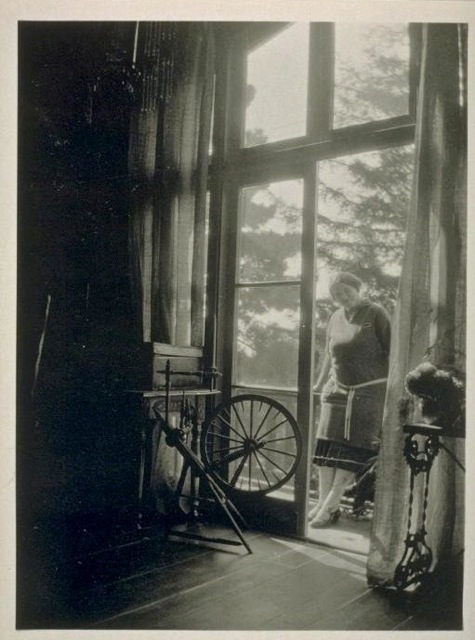
My great-mother Jennie in her studio, about 1924


“I don’t mean to be rude,” I said. “This was my great-grandparents’ house.”

 “Who were they?”

 “Dr. William Austin Cannon—” he interrupted,

 “Any relation to Jennie?”

 “She was his wife,” I said. “How do you know her?”

“Everyone here knows Jennie,” he said. “This was an artist’s enclave; she was a key part of it.”

 I was stunned. I had no idea. A stranger who had never met my family knew more about my great-grandmother than I did.

 I thanked him. Before I left, I looked one more time at the view, and saw another chunk of story.


"The Campanile," by Jennie Vennerstrom Cannon

I had always wondered about the odd foreshortened perspective in my great-grandmother’s painting of the Campanile. Now I could see Jennie had painted it from her porch high above the campus, only she had turned the tower a quarter turn.

 In that visit, I discovered a story and a bond with the great-grandmother who died before I was born. She was a noted California painter in the early 20th century, a time when the terms “noted painter” and “woman” did not often go together.

 I’m no artist, but I’ve always been independent, and walked my own path. I have also always searched for stories in the landscapes around me. Perhaps those are her gifts.

Thanks, Jennie, for sharing your view.
 

Award-winning writer and teacher Susan J. Tweit is a field ecologist who studied grizzly bears and wildfires before falling in love with the stories the data revealed. She has won national and regional awards for her work, including twelve books--the most recent is the memoir Walking Nature Home, hundreds of of articles and essays for magazines and newspapers from Audubon and Popular Mechanics to the Los Angeles Times, as well as commentaries for public radio. Her blog, hailed as "rich in the wisdom of one come face-to-face with the fragility, beauty and poetics of everyday life," chronicles her efforts to take life with love and honesty, or to paraphrase songwriter Mary Chapin Carpenter, "with my heart outstretched as if it were my hand."
Photo by Roberta Smith   Visit Susan's blog for more information http://susanjtweit.com